
The Playoff-Tailored Players
Recapping the first two playoff rounds by analyzing a few standout postseason risers.

The Conference Finals are here. Four teams remain, while the other twelve are likely enjoying their favorite Caribbean islands now.
This distinction, though often stated, is crucial: both teams and players are built for playoff demands, which differ from those of the regular season.
A great NBA player in the regular season doesn’t always shine in the playoffs. The difference begs the question: what separates great postseason performers from the rest?
A great regular-season NBA player doesn’t make a great playoff performer, but why?
Very few cases involve the human component, also known as the Jarrett Allen effect.
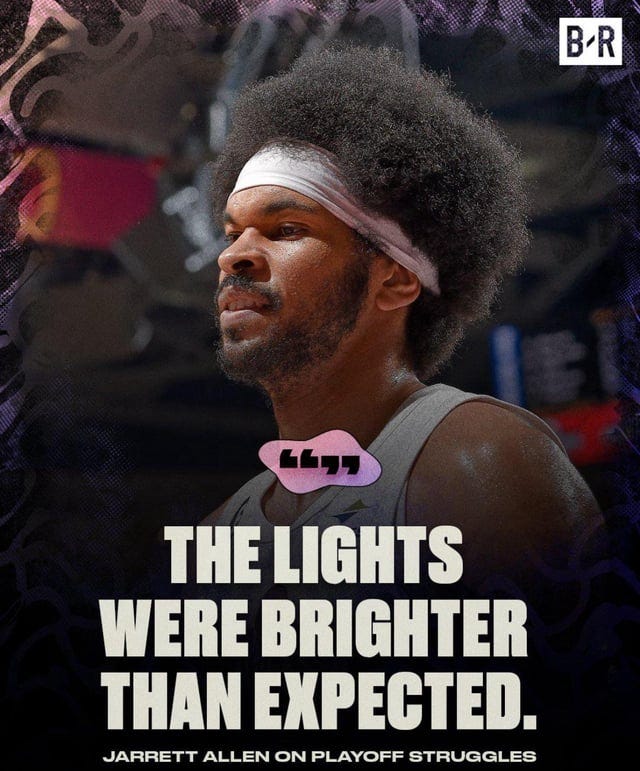
More often than not, the core reason lies in the basketball itself and adaptability to environmental shifts, so who’s not only survived but thrived in the stark contrast that is playoff basketball?
Dylan Harper
What Dylan Harper is doing as a rookie guard in high-leverage games is almost unprecedented — names like Magic Johnson have had this level of playoff production in their first year in the league.
Historically, pace takes a hit in the postseason, but the Spurs played at a blistering 102.5 pace in the series against Minnesota — a style that favored the Spurs’ #2 overall pick.
On four possessions a game, Harper shoots 81.8% true shooting and averages 1.41 points per possession. It’s likely unsustainable, but over two playoff series in his debut, his efficiency—especially for a 20-year-old—is bafflingly elite.
Harper’s composure is remarkable; his craft and downhill footwork are the best of his game. Few could have predicted such effectiveness against a decorated Wolves team.
He leads all playoff guards in rim attempts per 75 possessions (7.41) and shoots 69.6% at the rim, slicing through defenses despite intense scouting and physicality.
Stan Van Gundy made a good point regarding the Wolves’ defensive scheme when analyzing game six, highlighting how he would bring the ball pressure down against San Antonio.
Whether that would have worked is unclear, but what’s obvious is how Harper thrived off extended-ball-pressure and used Minnesota’s tactics against them.
Dylan Harper has redefined the court of basketball public’s opinion, which, mind you, was already held in high esteem, and proven that De’Aaron Fox won’t be entitled to the keys for much longer.
Ajay Mitchell
It’s ahead of schedule, and tricky southpaw guards are a theme, as Ajay Mitchell has starred in rounds one and two.
The OKC Thunder, a team where your impact can get blended with their other high-level role players, somehow, yet Mitchell stands out.
In 211 playoff minutes, OKC posts a 140 offensive rating with Mitchell on the floor and a +27.9 on/off rating.
It’s no coincidence these metrics favor Mitchell to such extremes; Mitchell is scoring 26.8 points per 75 on 7.1 assists and an unnoticeable 1.2 turnovers, shooting an extremely efficient 66.7% on twos in the series.
He now looks like more than an off-the-bench scoring option—he’s a real offensive engine and the Thunder’s second option after the MVP. In clutch moments, SGA has deferred at times to Mitchell, trusting him with entire possessions.
Much like a seasoned chef trusting his sous chef with the food critic’s meal, SGA has shown confidence in Mitchell.
These two lefty guards are well-adapted to the playoffs, not because they have the scars to prove it, but because their play style and particularly effective skill grant them so.
Mitchell and Harper are unquestionably special talents and have incredibly promising futures as lead guards on contending teams, so of course, they are poised for the big moments — the specific causation, though, is how easily they apply pressure to defenses.
Ball pressure and physicality are constants in this season. Hand-fighting, swimming through picks, arm-locking, and stiff-arming peak now.
These guards manipulate a high ball screen, break down defenders, and work tight lanes. They don’t just survive playoff intensity—they flourish thanks to self-sufficiency.
Even if they never amount to elite outside shooting, being able to get the cup at will so smoothly by their own merits negates all those concerns.
A ridiculous 64% of Mitchell’s field goals in OKC’s 8 games are unassisted, an astounding rate for a supposed role player who’s expected to finish others’ shots.
50% of Harper’s makes are unassisted—also elite, especially given his unmatched efficiency.
The playoffs are the deep end. Mitchell and Harper aren’t treading water—they’re synchronized swimming.
Ausar Thompson
In stark contrast to the aforementioned guards, Ausar Thompson has been an enormously impactful playoff performer despite his offense.
Thompson averages 7.3 steals and 4.3 blocks per 100 in round two—numbers that lead playoff guards and trail only Victor Wembanyama overall.
Ausar is a nightmare for Harden and Donovan Mitchell. Despite Atkinson’s desire to use his two top creators, he’d be better off with Max Strus or Sam Merrill creating their own shots.
According to databallr, in 154 possessions with Ausar guarding, Donovan Mitchell scored 21 points on a 26 effective field goal percentage. In 71 possessions, Harden scored just 2 points at 2% EFG.
Maybe the Pistons move onto the final four if Ausar wasn’t one of the spacing perpetrators…
Yes, Detroit and its putrid offense were eviscerated in Game Seven, but I cannot imagine this getting there in the first place without Ausar’s straightjacket confinement on Cleveland’s star-studded scorers.
If you feel convinced that Ausar’s elite defense isn’t even enough to neutralize poor offense, you and Channing Frye can yap all you want about it.
There are only two players on the Pistons who are shooting at an above-average clip, so look to the rest of the team, maybe not just one guy?
Would this even be a series if Detroit didn’t have the best defender?
Ask iso-hunters Harden and Mitchell how they like being stranded with Ausar.
Out of all the high-minute Pistons, Ausar had the best net rating with a +14.6 and a 99.4 defensive rating with him on the floor.
Thompson isn’t a one-trick pony; he’s an exceptional rebounder and transition asset due to unmatched athleticism.
Beyond Wemby, the most impactful defender, Ausar holds the title—even if you think he is a one-trick pony, few tricks top this.
He’s in the top five in deflections, forced turnovers, and stop %. Detroit’s defense is three points better with him, dropping to 108.5.
The context should not need to justify why Ausar’s game is portable to the postseason. Ausar Thompson’s defensive prowess and versatility are perfect for the postseason, so it shouldn’t come as a shock that he’s playoff certified.
Karl Anthony Towns
The KAT experience is unique: Is he New York’s biggest liability or Jokic in aggregate?
Rounds one and two haven’t stress-tested KAT like prior years, but he’s held his own.
New York had a 102.6 defensive rating with KAT vs. Atlanta in round one, and a 108.3 against Philly.
These are positive signs, but Embiid’s lack of mobility and the Hawks’ weak frontcourt haven’t tested this theory. We’ll see more in the Conference Finals. The Knicks’ defense has been excellent, so perhaps KAT doesn’t need to be hidden.
Mike Brown has unlocked KAT’s passing in the playoffs, maximizing what was once a unique skill.
He’s averaging 6.2 rim assists per game—staggering in Brown’s motion offense, which leverages all of KAT’s big-guard skills.
Shax tracks the Knicks with great X’s and O’s detail—better insights into KAT’s playoff rise than I could provide — so go check him out.
From above, the key to the elbow extended on both sides, KAT has been able to orchestrate the offense and pick his poison through a variety of off-ball actions — and when KAT is waiving the baton, the Knicks offense is a pure symphony.
AKA, he’s given them a +2.1 boost in true shooting percentage on the floor; this easy offense looks like it is accomplished mostly by way of initiating everything through the KAT.
KAT’s scoring averages and shooting volume as a whole are down, but he’s creating 5 more points a game than his regular-season average — this current offensive system allows him to be more efficient, while keeping him involved with the proper amount of touches.
KAT may be an acquired taste, but this edition—a premier playmaker—is his best playoff self thus far: a rendition of him that is truly built for the moment.
As we’ve seen, several stars have stepped up, but some deserving shout-outs remain. I didn’t hit everyone, like Wemby’s utter dominance, Ant willing his team to two wins through his scoring despite playing on two crippled legs, or how LeBron found a way to surprise me at his ripe old basketball age of 41 and leave his mark on the game entirely through his basketball intellect.
The playoffs, or certain series, aren’t for everyone — I’m looking at you, Julius Randle, Brandon Ingram, and DeAndre Ayton…
All this to say, it fascinates me how he discusses player hierarchy, because if you pay close enough attention in April-June, it’ll help you disregard what’s just empty flash and numbers during the drawn-out regular season.
let’s go KAT!!!
so awesome G